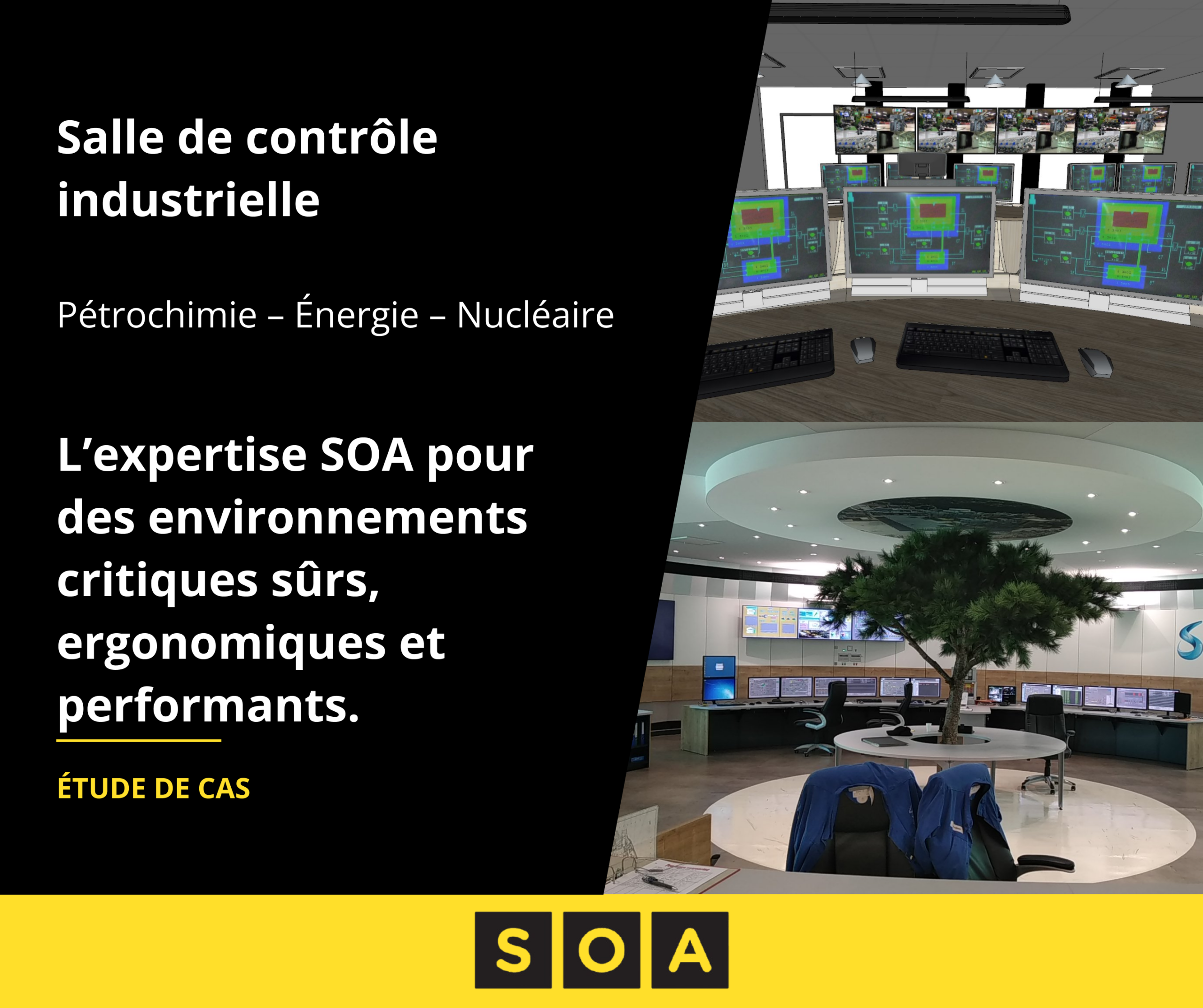
Introduction: When the Control Room Becomes a Matter of Industrial Safety
In critical industrial environments—such as refineries, power plants, and petrochemical facilities—the control room is not merely a monitoring station. It is the central nervous system of the entire facility. A misreading, poor posture, a poorly positioned screen, or background noise can be enough to trigger an incident with serious consequences.
That is why designing an industrial control room cannot be done on the fly. It requires expertise across multiple disciplines: ergonomics, acoustics, interior design, project management, and a thorough understanding of the regulatory requirements specific to each industry.
Since 1975, SOA has been working with major players in the French petrochemical, nuclear energy, and heavy industry sectors to design and equip their control rooms. Here’s what sets a well-designed industrial control room apart from one that puts your operators and processes at risk.
1. The specific challenges of the industrial environment
Non-stop operation with no room for error
Unlike a traditional office, an industrial control room operates 24 hours a day, 365 days a year, with three-shift rotations. Operators monitor dozens, sometimes hundreds, of parameters simultaneously: temperatures, pressures, flow rates, and alerts. Fatigue is the number one enemy of safety.
Every design decision— console height, screen tilt angle, lighting level, and acoustic treatment—has a direct impact on the operator's alertness and, therefore, on the safety of the facility.
Regulated and certified environments
Depending on the industry, industrial control rooms are subject to strict regulatory requirements:
- Petrochemicals and heavy industry:application of ATEX standards for areas at risk of explosion, and safety management systems validated by theMASE certificationheld by SOA.
- Nuclear:Work in controlled areas is subject to radiation protection regulations. SOA isQUALIANOR-certifiedto perform work in Basic Nuclear Facilities (INB).
SOA is one of the few companies in the market to hold both of these industry certifications, enabling it to operate at the most challenging sites in France.
2. Ergonomics at the Heart of Industrial Performance
The Operator Console: Built for 24/7 Operation
A standard office desk rarely lasts more than two years under continuous use. SOA manufactures its own operator consoles in France, using materials and mechanisms designed for heavy-duty industrial use:
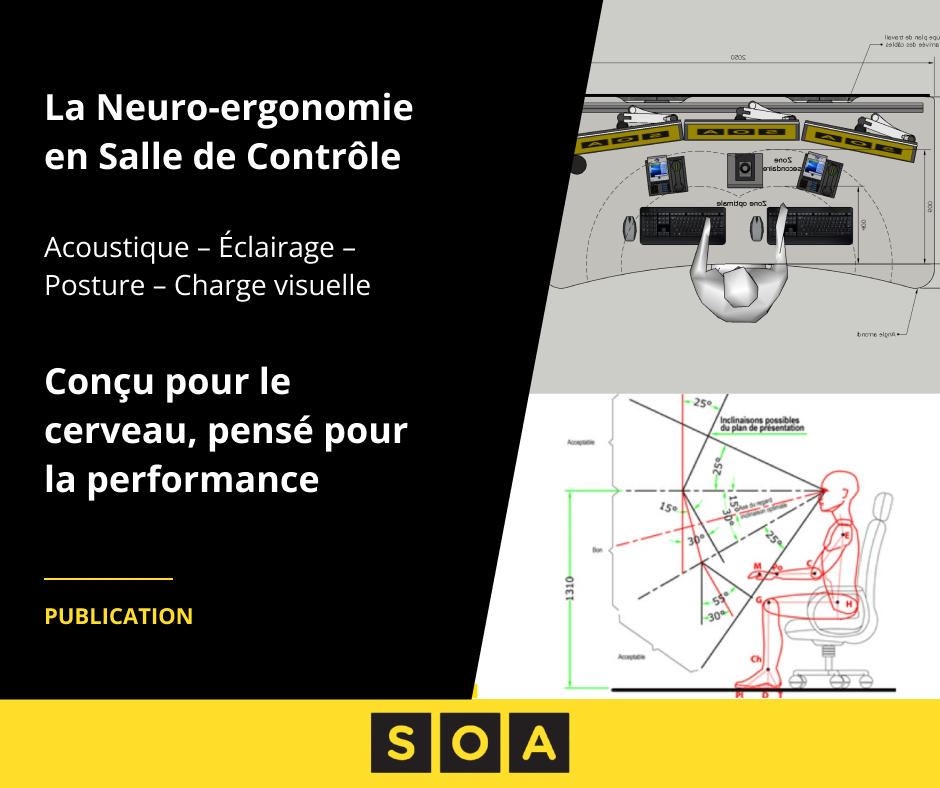
- Deep work surface to position monitors at the correct viewing distance and reduce eye strain during long shifts
- Electric height adjustment(sit-stand) to alternate postures, improve circulation, and prevent musculoskeletal disorders during 8- or 12-hour shifts
- Flush-mounted connectors(HDMI, RJ45, USB, power) fully integrated into the tabletop to eliminate visible cables and facilitate maintenance
- Continuously laminated edges that are impact- and abrasion-resistant, ensuring durability suitable for industrial environments
The operator's station: certified 24/7
It is the most frequently used piece of equipment in a control room, yet it is often overlooked. SOA exclusively selects chairs certified for 24-hour use, featuring adjustable lumbar support, a synchronous mechanism, and adjustable armrests. In an environment where the operator spends their entire shift sitting, this isn’t just a matter of comfort—it’s an occupational health requirement.
Layout: Viewing angles and traffic flow
The layout of an industrial control room must comply with specific design guidelines: optimal viewing angles between each workstation and the video wall, no doors behind the operators, and unobstructed pathways to allow maintenance teams to respond quickly. SOA systematically conducts a preliminary layout study, including 2D plans and 3D renderings, before work begins.
3. Video wall and supervision: seeing in order to decide
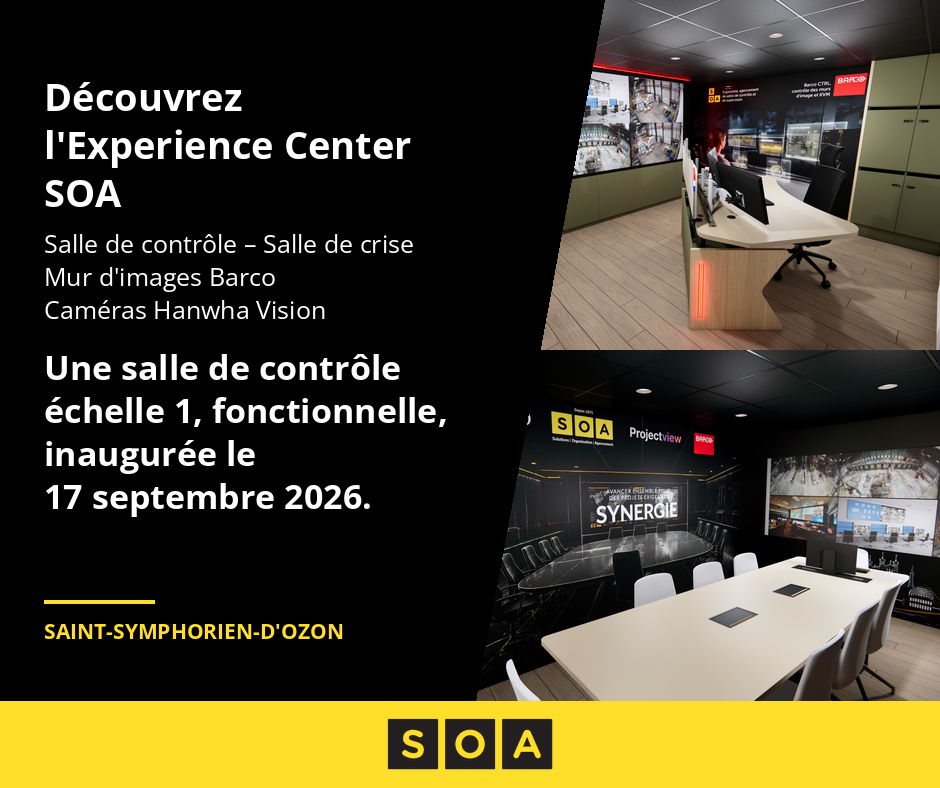
In an industrial control room, the video wall brings together all critical information: process overviews, alerts, maps, and video feeds. Its integration directly determines the operators’ ability to detect anomalies in real time.
SOA designs and installs custom video walls, taking three fundamental factors into account:
Technology tailored to the industry.LED panels, DLP cubes, or professional LCD screens: each technology has its own advantages depending on the room size, viewing distance, required refresh rate, and environmental conditions (dust, humidity, vibrations). SOA provides unbiased technical advice.
Architectural integration.We design custom structures—such as built-in niches and custom wood paneling—that incorporate display arrays while ensuring rear access for maintenance and effective equipment ventilation, which is particularly important in hot environments.
Visual ergonomics.We calculate viewing distances and mounting heights so that no operator has to tilt their head uncomfortably, and so that critical information remains visible from every workstation in the room.
4. Acoustics and lighting: the two most underestimated factors
Industrial Acoustics: Reducing Noise to Reduce Errors
In an industrial control room, noise sources accumulate: audible alarms, radio communications, team discussions, and vibrations transmitted through the structure. Without proper acoustic treatment, the room amplifies these disturbances and causes auditory fatigue, which reduces alertness and increases the likelihood of communication errors.
SOA systematically incorporates high-density sound-absorbing materials—acoustic ceilings and treated wall panels—to maintain a controlled noise level. The goal is simple: every operator must be able to hear and be heard clearly, without raising their voice, even during periods of intense activity.
Biodynamic lighting for 3×8 shift rotations
In a 24/7 environment with rotating shifts, lighting plays a direct physiological role. SOA integrates biodynamic lighting systems whose intensity and color temperature change throughout the day to mimic the sun’s natural cycle. This system supports operators’ circadian rhythms, reduces fatigue among night shifts, and contributes to their well-being and long-term performance—a particularly critical issue in industries where sustained alertness is a matter of safety.
In addition, SOA takes steps to eliminate sources of glare and reflections on screens: positioning screens perpendicular to windows, installing motorized blinds, and using lighting fixtures with very low luminance (UGR-controlled).
5. From Design to Delivery: SOA Project Management
SOA is not a furniture supplier that delivers desks in kit form. We act asa full-service general contractor, from the design phase through project completion:
- Functional and Ergonomic Study— Needs Assessment, Equipment Inventory, Workflow and Access Control Definition
- Architectural design— 2D plans and 3D renderings to validate each decision before construction begins
- Custom furniture manufacturingin France (wood, glass, metal), with guaranteed lead times and a single point of contact
- Construction site coordination— managing trades, adhering to schedules, and addressing operational continuity requirements specific to active industrial sites
- Onboarding and Support— An SOA project manager remains your dedicated point of contact until final delivery
This comprehensive project management approach is particularly well-suited to active industrial sites, where work must be carried out without interrupting production or compromising the safety of the facilities.
They trust us
For decades, SOA has been working with the leading names in French and international industry:Total, Solvay, Engie, Orano, EDF/RTE, Arkema, Vencorex, Eiffage Industrie, SPIE, SNEF, and Actemium.
Every project is unique. Every control room we design is the result of a custom study, tailored to the specific requirements of the industry, the site, and the teams that will be working there.
Conclusion: Don’t let your facility layout be the weak link in your industrial safety
A poorly designed industrial control room poses an operational risk. The consequences of human error caused by a poor work environment—fatigue, glare, noise, and poor posture—can far outweigh the cost of a well-designed layout from the outset.
Are you planning to build, renovate, or revamp an industrial control room?Contact SOA’s design office for an initial consultation with no obligation →