Introduction: Human error is not just a matter of competence
Errors in the control room almost never occur because an operator is poorly trained. They occur because the operator is tired. Because noise distracted them at the wrong moment. Because the lighting disrupted their circadian rhythm at 3 a.m. Because their posture, maintained for too long in an awkward position, reduced blood flow to the brain—and with it, their decision-making abilities.
This is precisely what neuroergonomics addresses. Not the operator himself, but the environment in which he works.
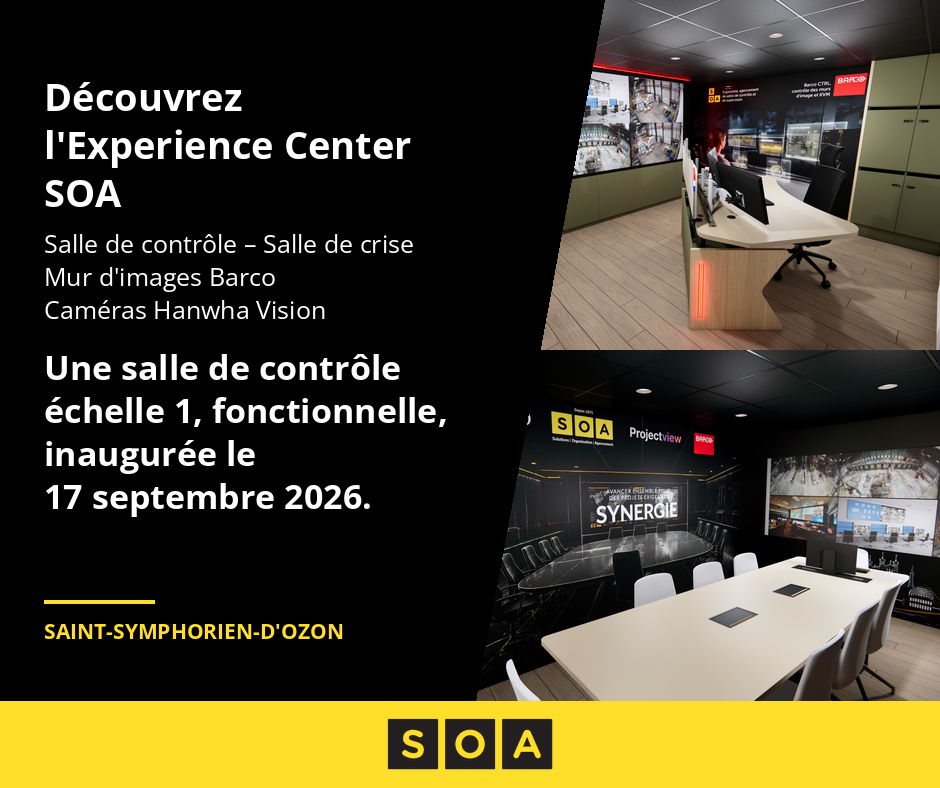
For fifty years, SOA has been designing control rooms for the most demanding industries—nuclear, petrochemical, transportation, and defense. What you quickly learn when working on these sites is that a well-designed control room isn’t just functional. It actively supports the cognitive functions of the people who operate it. That’s the difference between a room that demands a lot and a room that adapts to the people who work in it.
What is neuroergonomics?
Neuroergonomics applies insights from neuroscience and cognitive psychology to the design of work environments. It starts with a simple observation: the human brain is directly influenced by its physical environment—light, noise, temperature, posture, and visual load. This isn’t a luxury. It’s neural physics.
In an industrial or urban monitoring setting—where operators work in three-shift rotations, monitor 50 to 200 parameters simultaneously, and make high-stakes decisions—this impact is not merely theoretical. It is the difference between alertness that lasts eight hours and alertness that wanes by the sixth hour.
It addresses four fundamental questions. How can we reduce cognitive load without losing critical information? How can we maintain alertness over time? How can we prevent sensory fatigue? How can we facilitate decision-making under pressure?
1. Acoustics: Reducing cognitive load through controlled silence
Noise is the silent enemy—and that expression really rings true here. In the monitoring room, noise sources pile up: alarms, radio communications, conversations among operators, equipment vibrations, and air conditioning. Without acoustic treatment, the room amplifies these disturbances and causes auditory fatigue that undermines concentration, often without the operator even realizing it.
Neuroergonomics clearly demonstrates this: the brain devotes cognitive resources to filtering out background noise. These resources are then lost—they are no longer available for monitoring and decision-making. Reducing ambient noise levels therefore directly frees up cognitive capacity.
SOA incorporates high-density sound-absorbing materials—acoustic ceilings, treated wall panels—custom-designed for each layout. The goal is not absolute silence (which would be unsettling in an monitoring room), but a controlled noise level. Each operator must be able to hear and be heard clearly, without raising their voice, even during peak activity.
2. Biodynamic lighting: respecting the brain that works at night
Light synchronizes the human biological clock. Period. In a 24/7 environment with rotating shifts, night shift workers are working against their natural circadian rhythm. Their brains send sleep signals at 3 a.m. — exactly when they need to be most alert.
Fixed lighting exacerbates this conflict—whether it is too bright or too dim. Biodynamic lighting does the opposite. It mimics the natural progression of sunlight: cool, stimulating light at the start of the shift, and warmer, soothing light as the shift draws to a close. This supports the circadian rhythm, reduces fatigue among night shift workers, and improves their performance over time.
SOA systematically incorporates these dimmable lighting systems with adjustable color temperature into rooms that operate around the clock. At the same time: elimination of all glare and reflections on screens—positioning perpendicular to windows, controllable electric blinds, and luminaires with very low luminance (UGR-controlled). Eye strain during a 12-hour shift is a serious concern.
3. Visual load: organizing information to make quick decisions
An industrial operator monitors between 50 and 200 parameters simultaneously. The way this information is presented—and the placement of the screens—has a direct impact on the operator’s ability to detect an anomaly and respond in real time. That is the crux of the matter.
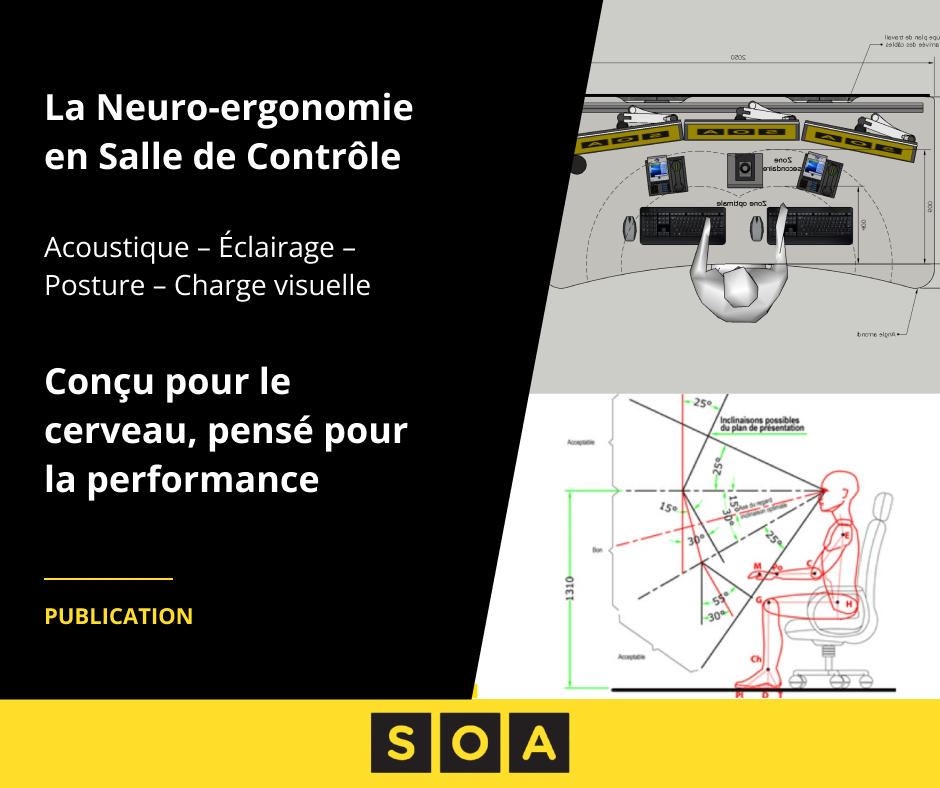
Neuroergonomics establishes specific principles: critical information must be located within the direct line of sight (30° around the central point of gaze), alerts must be visually distinguishable from routine data without overwhelming the visual field, and viewing distances must allow for comfortable reading of displays without straining the eyes.
SOA conducts a comprehensive layout study for each project. This includes calculating the viewing angles between each workstation and the video wall, determining screen heights, and positioning workstations to avoid prolonged torso rotation. The study is presented in 2D drawings and 3D renderings before work begins—for approval by the operational teams. They are the ones who know whether it works or not.
4. Furniture: The Body as the Primary Driver of Cognitive Performance
Posture directly affects cognitive function. It’s a neurological issue. An operator who remains stationary in a poor posture experiences reduced blood flow and restricted breathing, which in turn reduces oxygen supply to the brain. Over an 8- to 12-hour shift, this effect accumulates.
SOA manufactures its operator consoles in France with electric height adjustment, allowing users to alternate between sitting and standing. This isn’t just about comfort. It’s a neuro-ergonomic necessity. Changing your posture every 1 to 2 hours boosts circulation, reduces muscle fatigue, and maintains a higher level of brain activity—which is measurable.
The desk depths are designed to position monitors at the optimal viewing distance (60 to 80 cm), reducing eye strain. Connectors are flush with the desktop. No cables lying around. No additional postural strain to add to the workload.
Conclusion: Design for the brain, not for the brochure
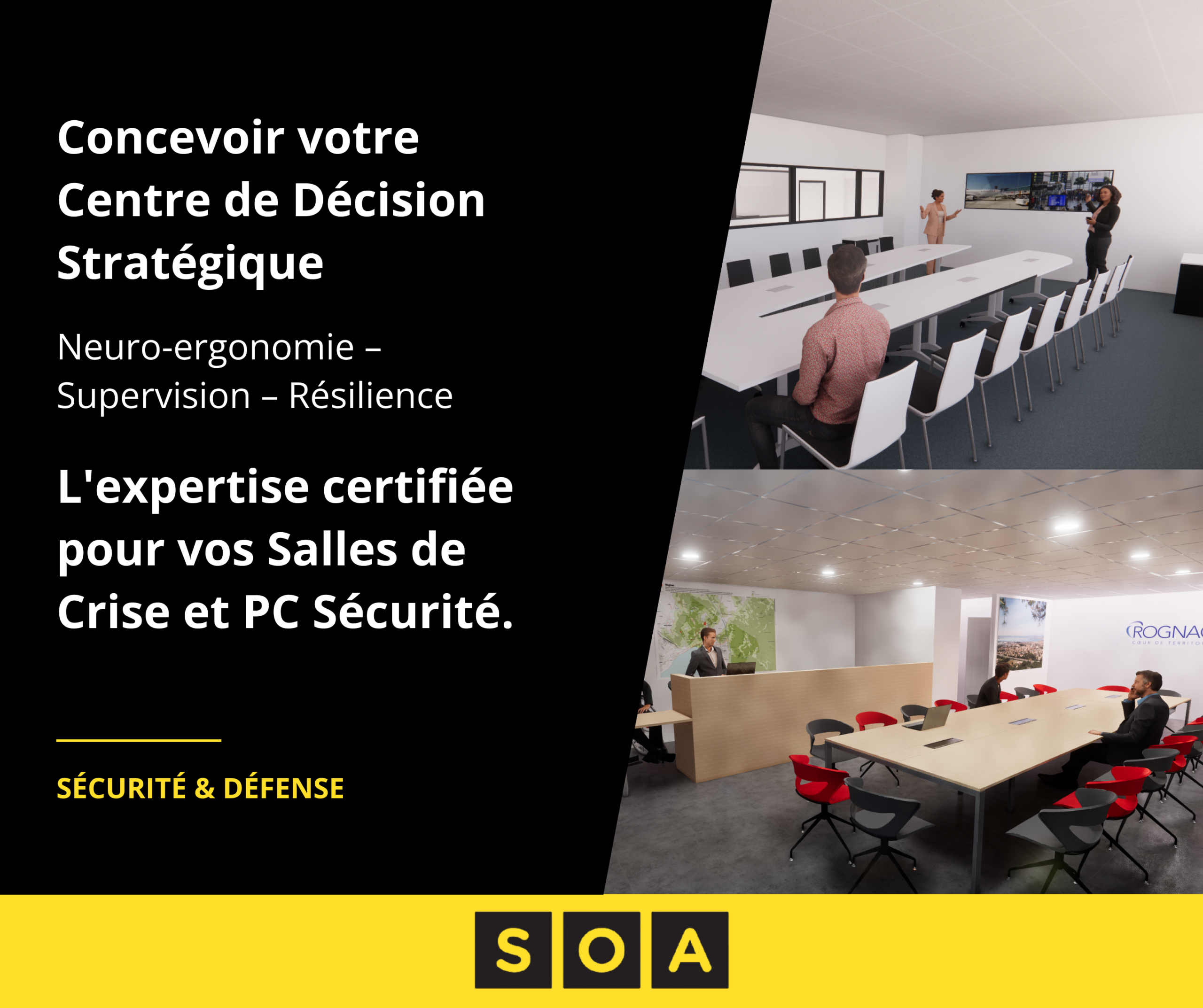
A neuroergonomic control room is no more complex to design than a standard control room. It requires that every design decision— console height, acoustic treatment, lighting levels, and monitor placement—be guided by a single question: What impact will this have on the alertness and cognitive performance of the operator who will be working there for 8 hours?
This is the approach SOA has been using for fifty years at nuclear facilities, urban monitoring centers, command centers, and airports.
Are you designing or renovating a control room? Talk to our engineering department.