
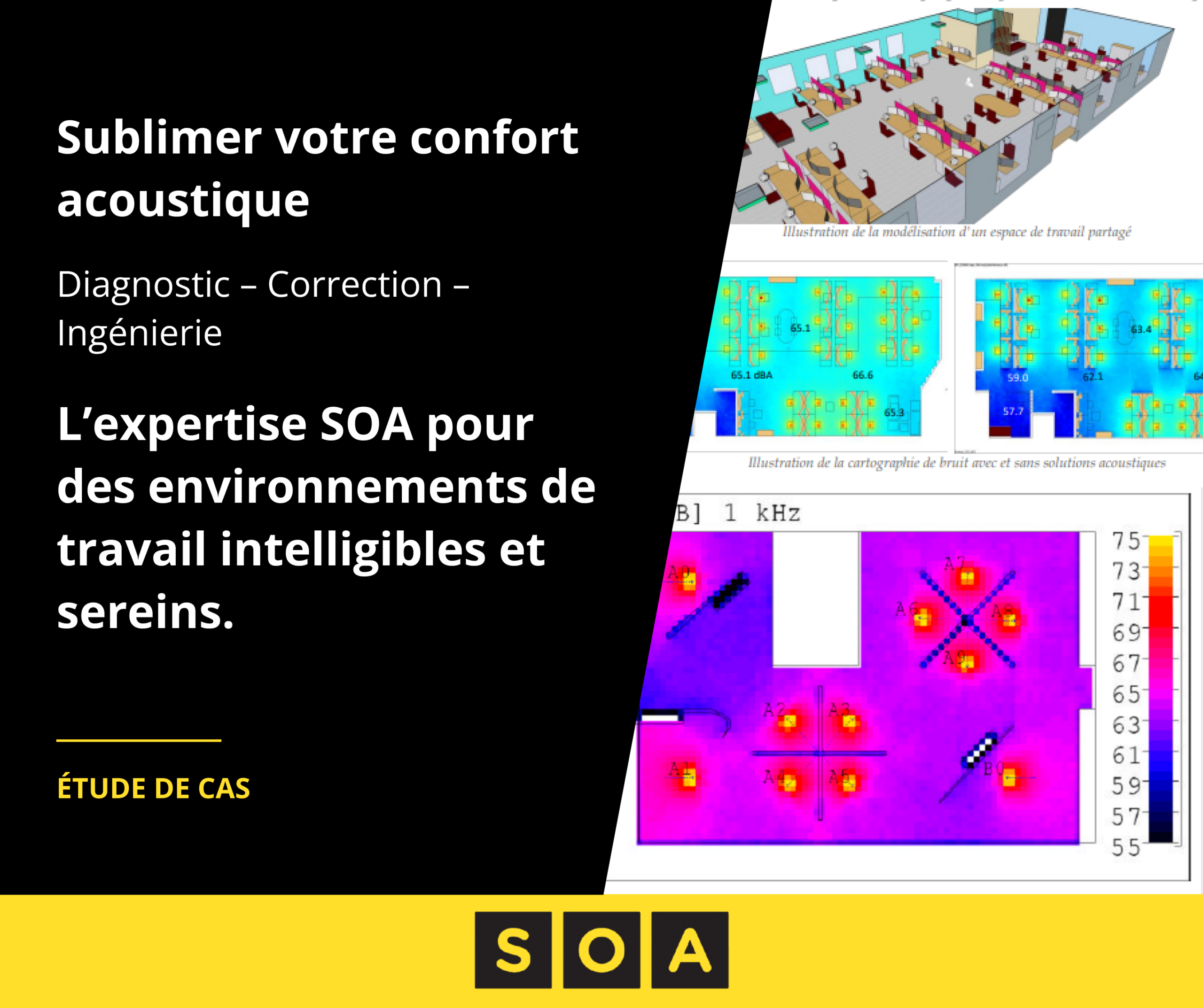
When designing professional spaces, the premises play a decisive role in workers' exposure to noise. Due to its reverberation, an untreated room increases the noise level coming from machines or conversations and affects the entire workspace. At SOA, we tackle the problem at its root to transform your environments into intelligible and serene spaces.
1. Diagnosis: Insulation vs. Acoustic Comfort
It is crucial to distinguish between two phenomena that our clients often confuse:
- Sound insulation: This is protection against external noise or noise between floors, generally governed by regulations and addressed through structural work or glazing.
- Acoustic comfort (or correction): This is our core business. It involves covering part of the walls with absorbent material to limit noise reverberation inside the room. In modern premises (high ceilings, bay windows, smooth materials), the absence of absorbent materials makes conversations difficult and increases cognitive fatigue.
Did you know? Acoustic correction does not sacrifice aesthetics. On the contrary, it enhances them.
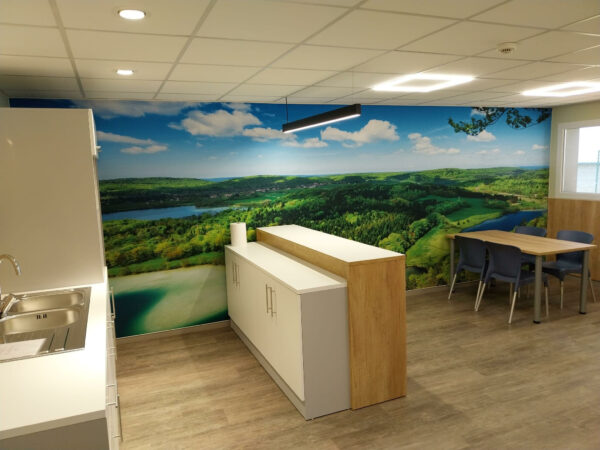
Here is one of our recent projects: a large, high-performance acoustic panel, custom-designed to incorporate absorbent material that significantly reduces reverberation and improves intelligibility within the room.
2. How to reduce noise in the office? Our 3-step methodology
We don't install solutions at random. True to the principles of prevention, we follow three key steps:
- Step 1: Eliminate or reduce the source. Before any treatment, we analyze whether the noise can be stopped or reduced (e.g., moving a noisy photocopier, covering a machine, or using a headset to reduce the volume of operators' voices).
- Step 2: Capture as close as possible. The closer the absorbent is to the source (the mouth, the machine), the smaller and more effective the treatment area required.
- Step 3: Treat the room. The goal is to control reverberation by absorbing some of the sound energy each time it reflects off the walls. This approach reduces the overall sound level and improves intelligibility by promoting a more noticeable decrease in sound level with distance from the source.
3. Our Acoustic Treatment Solutions
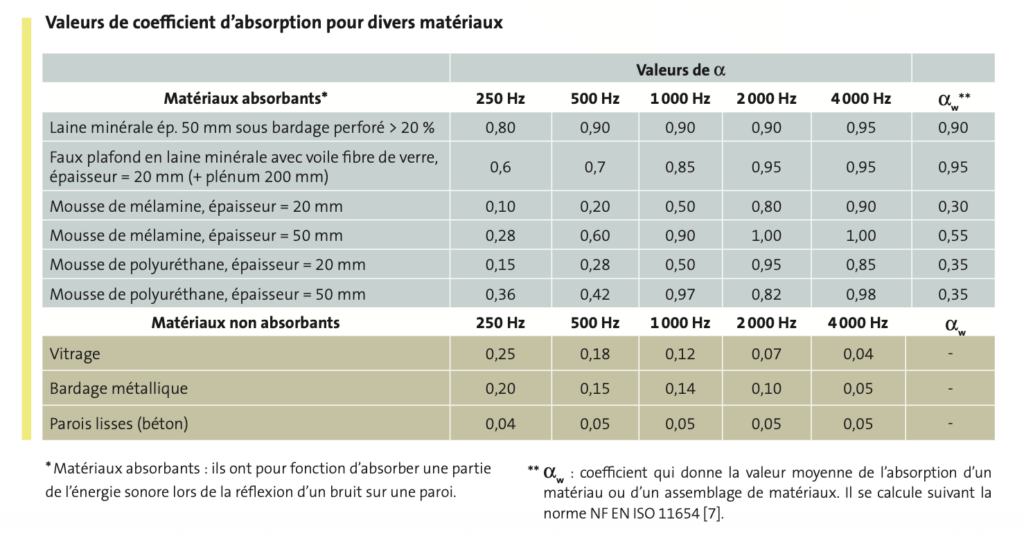
We use absorbent materials (mineral wool, melamine foam, polyurethane). Their performance is measured by the Alpha Sabine absorption coefficient (α), ranging from 0 (reflective material) to 1 (totally absorbent material).
Understanding sound absorption coefficients
The absorption coefficient α varies according to:
- frequency (Hz)
- the thickness of the material
- the presence of a plenum
- the nature of the medium
The values below illustrate the typical performance of different materials used in acoustic treatment of professional premises.
Ceilings and Walls
- Ceilings and false ceilings: The most consistent solution covering a large surface area. We install high-performance tiles, often leaving an air gap, called a plenum, which significantly increases absorption.
- Suspended baffles: Installed vertically or horizontally (above workstations), they are sometimes more effective than a false ceiling, particularly for treating low frequencies. They can be placed close to noise sources.
- Stretched fabrics: Combining aesthetics with technology. Acoustic fabric eliminates the need for finishing touches (paint, joint tape) while incorporating high-performance insulation behind a decorative finish.
- Acoustic objects: Acoustic office partitions, acoustic panels or boards, sound-absorbing furniture, or stabilized greenery.
- Directional speakers: To prevent noise pollution, we install speakers with a narrow diffusion cone. The operator can hear radio transmissions clearly, but the sound fades away as soon as you move away from the station.
- Image walls: We use the areas below the screens to integrate strategic absorbent surfaces.
- Flooring: Carpet offers a slight degree of absorption. However, as it is often ruled out due to maintenance issues, we recommend using technical PVC flooring. This effectively reduces impact noise (from chairs, footsteps, etc.) compared to hard surfaces such as tile or parquet.
4. Design Office: From measurement to commitment
SOA does not just install products. We provide a comprehensive engineering service carried out by an acoustician:
- Diagnostics and Modeling: On-site measurements (LAeq levels and RT60 reverberation time) or predictive calculations using numerical simulation (such as INRS Rayplus).
- Prescription: Definition of comfort objectives (e.g., Tr = 0.6 s) in accordance with standards NF S 31-080 and NF ISO 22955.
- Validation: A final series of measurements is carried out at the end of the project to ensure compliance with the requirements of the Labor Code (Art. R 4213-5).
Why go through with this study?
The involvement of an acoustician helps to avoid costly "over-treatment" or, conversely, insufficient installation. It ensures a controlled investment for lasting acoustic comfort.
SOA: Acoustic engineering for your peace of mind
Reference source: Acoustic treatment of workplaces, INRS ED 6103, 2019.